Whether you’re aiming to sharpen your groundstrokes, improve footwork, or build consistency during solo practice, a tennis ball pitching machine can be a game changer. The following selections emphasize ease of use, adjustable speeds, and realistic ball placement to simulate match conditions. Each option below highlights unique strengths—from portability to multi-sport versatility—so you can find a machine that fits your court, budget, and practice goals.
Summary table of chosen products:
| Product | Key Strengths | Battery/Power |
|---|---|---|
| Furlihong 3819BH Portable Tennis Ball Machine | 5 angles, 2 power levels, up to 30 mph | AC power or battery |
| PUSUN PT-Smart Tennis Ball Machine | 11 training modes, 20 landing points, 5-hour battery | External lithium battery |
| Furlihong 681TPCBH 4-in-1 Machine | 4 sports in one, auto-oscillation | Battery/AC/power bank |
| Spinshot Pro Tennis Ball Machine | User-friendly knob controls, durable build | Flexible power options |
| iPlay, iLearn 2-in-1 Pitching Machine | 2 modes for kids and beginners, combined baseball/tennis features | Battery powered |
Furlihong 3819BH Portable Tennis Ball Machine

The Furlihong 3819BH model focuses on practical portability and straightforward tuning for solo practice. Its five adjustable angle settings support forehand, backhand, flat, slice, and volley drills, enabling players to work on a well-rounded stroke repertoire without needing a partner. Two power levels and four serve intervals let you tailor the pacing of feeds to your progression—from rapid-fire rallies for reaction time to longer gaps for technique checks. The lightweight design makes it convenient to move between courts or storage areas, making it a solid option for personal training on any surface.
PT-Smart Tennis Ball Machine

The PT-Smart stands out for its breadth of training modes and landing points. It offers 11 professional training modes spanning forehands, backhands, volleys, and horizontal swings, creating a thorough solo practice environment. With 20 programmable landing points, players can simulate court-wide patterns and improve accuracy, footwork, and anticipation. A five-hour external battery adds to its versatility, letting you train outdoors or indoors without frequent recharges. This machine is well-suited for players who want a robust, feature-rich solo practice tool with realistic ball placement.
Furlihong 681TPCBH 4-in-1 Pitching Machine
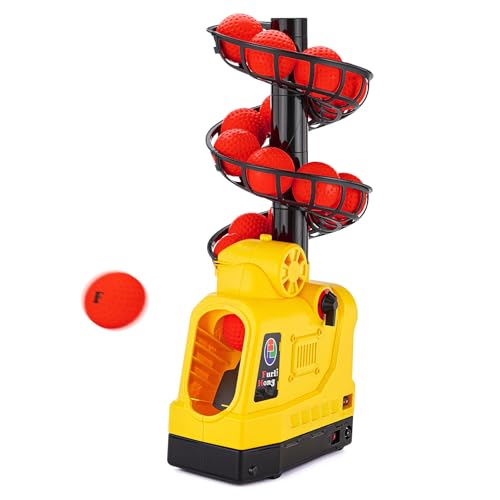
This 4-in-1 machine targets multi-sport training, including baseball, pickleball, tennis, and cricket, making it ideal for families or multi-sport athletes. For tennis practice specifically, it provides adjustable launch and auto-oscillation, which helps mimic in-game ball movement and keep drills dynamic. The auto-oscillation feature adds unpredictability to feeds, training reflexes and decision-making under varying trajectories, while adjustable launch distances support progression from beginner to more advanced levels. It’s powered by multiple options, increasing flexibility for different practice environments.
Spinshot Pro Tennis Ball Machine
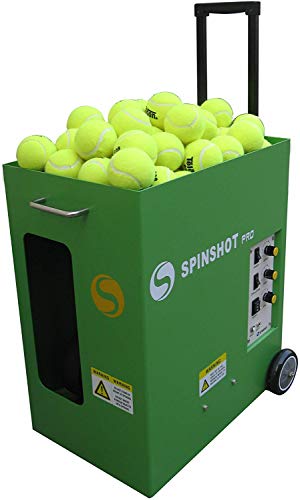
The Spinshot Pro emphasizes reliability and ease-of-use, with a design that avoids plastic-heavy construction for durability and consistent performance. Its knob-controlled interface is straightforward for players of all ages, including younger athletes. While it supports standard tennis drills, its user-friendly setup is a major advantage for households or clubs that want quick transitions between practice sessions. The machine offers flexible power options to suit indoor courts, garages, or outdoor courts, ensuring you can train regardless of venue.
iPlay, iLearn 2-in-1 Pitching Machine

The iPlay, iLearn 2-in-1 unit focuses on family-friendly versatility, combining baseball and tennis pitch capabilities in one compact package. It includes a base unit, a pitching mechanism, a baseball bat, a tennis racket, and a small set of balls. The dual modes accommodate both auto and RC-style control, making it a good option for younger players who are transitioning between sports. Battery-powered operation supports backyard setups where access to power outlets may be limited, though keep in mind the device requires a mix of battery types for full operation.
Buying Guide: Key Purchase Considerations
When choosing a tennis ball pitching machine, consider how you will train, the space you have, and the level of realism you need. Here are several factors to weigh to ensure you pick the best fit.
- Practice goals: Identify whether you want fundamental stroke practice, footwork and reaction, or advanced pattern drills. Machines with multiple modes and programmable landing points support progressive training.
- Portability vs. capacity: Lighter models are easier to move between courts, but larger machines may offer more features. A good balance is a model with a carrying handle and a practical weight for your space.
- Power options: Look for machines with battery-powered operation for outdoor use, plus AC compatibility for indoor practice. External batteries can extend practice time between charges.
- Speed range and spin variety: For beginners, lower speeds help build confidence; advanced players may need higher speeds and varied feeds (topspin, backspin, or side-to-side oscillation) to simulate real-match pace.
- Ball compatibility: Ensure the machine uses standard tennis balls or the specific training balls that match your drills. Some models also support alternative ball types for visual tracking and hand-eye coordination.
- Maintenance and durability: Durable housings and reliable feed mechanisms minimize downtime. Check for easy cleaning and simple replacement parts, especially for frequent use.
- Safety and setup: Clear space around the machine to avoid interference during feeds. Some models include safety features or covers to prevent accidental contact with moving components.
- Budget considerations: Higher-end models offer advanced programming and broader drill sets, while entry-level machines cover fundamental practice for solo players. Align features with how often you train and your progression goals.
Additional perspectives include evaluating the role of a multi-sport device for families or clubs, the value of integrated apps or remote control for consistency, and the advantage of models with realistic spray patterns to mimic match conditions. If you train with a partner occasionally, consider a machine that easily switches between autonomous drills and manual control.