Finding a roof mount basketball goal that blends durability, versatility, and straightforward installation can transform outdoor play. This guide reviews five top picks that support various mounting methods, backboard materials, and height adjustments to fit homes, garages, and small courts. Each option is evaluated for weather resistance, ease of assembly, and compatibility with common backboard systems. Use the summary table to compare key details at a glance, then dive into detailed product insights to choose the best fit for your space and playing style.
| Product | Brand | Mount Type / Backboard | Notable Feature |
|---|---|---|---|
| Buzzlett 9594 Mounting Kit | 3 BUZZLETT Store | Wall, Roof, or Pole Mount; Lifetime backboards only | Heavy-duty steel with anti-rust treatment |
| Spalding Universal Bracket | Spalding Store | Roof, flat surface, or 3.5″ round pole | Adapts to multiple backboard setups |
| Silverback NXT 54″ | Silverback Store | Wall mounted; indoor/outdoor | Infinity Edge backboard; adjustable rim height |
| Spalding Momentous EZ Assembly | Spalding Store | Portable outdoor; adjustable height | Fast setup; arena-style padding |
| 54.5″ Wall Mounted Defulion | Defulion | Wall mounted; adjustable height | Shatterproof PC backboard |
Buzzlett 9594 Mounting Kit

The Buzzlett 9594 mounting kit offers three installation options—wall, roof, or pole—to accommodate a range of setups. It is described as heavy-duty steel with anti-rust treatment, designed to withstand outdoor weather and intense play. Compatibility notes specify use with Lifetime backboards only, and hardware for roof and wall attachments is not included. Users should plan to source additional mounting hardware as needed. This kit focuses on durability and flexibility, making it a solid choice for households with a Lifetime backboard needing a robust mounting solution.
Spalding Universal Mounting Bracket

This mounting bracket from Spalding adapts to roof, flat surfaces, or a 3.5″ round pole and is designed to support most Spalding and Huffy Sports residential backboards up to 54 inches. It offers flexibility for various installation environments, making it suitable for garages, patios, or home courts with mixed backboard systems. The key benefit is broad compatibility and straightforward adaptation to different mounting surfaces, simplifying a custom setup without needing multiple specialized kits.
Silverback NXT 54″ Wall Mounted

The Silverback NXT 54″ wall-mounted hoop includes a backboard, rim, and mounting hardware designed for indoor or outdoor use. The backboard features the Infinity Edge design for added rigidity, and the rim height is adjustable from 7.5 to 10 feet, accommodating players of different ages. Its space-saving profile places the backboard closer to the wall, which helps reduce footprint while maintaining performance for casual play and training sessions.
Spalding Momentous EZ Assembly

This portable outdoor basketball hoop emphasizes quick setup, assembling in 30 minutes or less. It features a 54″ performance H-Frame acrylic board with arena-style padding and a sturdy steel board frame. The product is designed for portability and ease of use, making it a practical option for renters or those who want to move the hoop around to different locations on a property.
54.5″ Defulion Wall Mounted
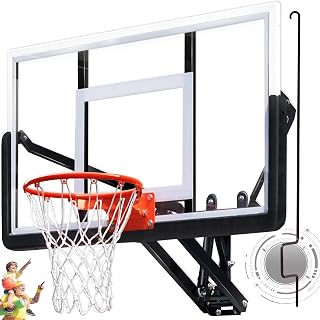
The Defulion 54.5″ wall-mounted hoop features a shatterproof PC backboard designed for durability in daily use. It includes complete mounting hardware with straightforward installation on concrete, brick, or garage walls. The height is adjustable from 7 to 10 feet, making it adaptable for players of all ages and skill levels. The backboard’s durability and reliable mounting provide a stable shooting experience for home gyms, driveways, or garage spaces.
Buying Guide
Key considerations when selecting a roof or wall-mounted basketball goal include backboard compatibility, mounting options, and environmental resilience. First, confirm backboard compatibility with mounting hardware to avoid purchasing incompatible kits. If you own a specific brand, such as Lifetime or Spalding, look for mounting kits designed for that system to ensure proper fit and warranty alignment.
Mounting options should align with space and structural support. Roof, wall, and pole mounts offer different levels of stability and future flexibility. Roof mounts may require additional hardware and roof integrity checks. Wall-mounted systems save space but rely on a solid wall and adequate anchoring. For portable needs, consider a system with quick assembly and easy disassembly for seasonal use.
Backboard material matters for durability and rebound consistency. Shatterproof PC backboards tend to offer better resilience in varied climates compared with standard acrylics. For outdoor use, weather-resistant frames and anti-rust coatings extend the life of your setup. If you live in areas with extreme weather, prioritize corrosion-resistant steel and sealants to reduce degradation over time.
Height adjustment ranges influence who can play and what styles you can practice. Wider height ranges (for example, 7.5 to 10 feet) accommodate both kids and adults. Consider whether the rim is adjustable independently from the backboard height, as some units offer more precise tuning for training drills and free-throw practice.
Installation hardware is a practical consideration. Some kits exclude essential mounting hardware, requiring extra purchases. Review the included components carefully and plan for additional hardware, wall anchors, or roof brackets as needed. If installation is challenging, seek models with clear setup guides or professional assembly options.
Finally, evaluate portability versus permanence. Portable systems are ideal for renters or variable spaces, while fixed installations deliver more stability and a consistent shooting experience. Your choice should reflect how often you plan to relocate the setup, the available space, and local building codes or HOA rules.